

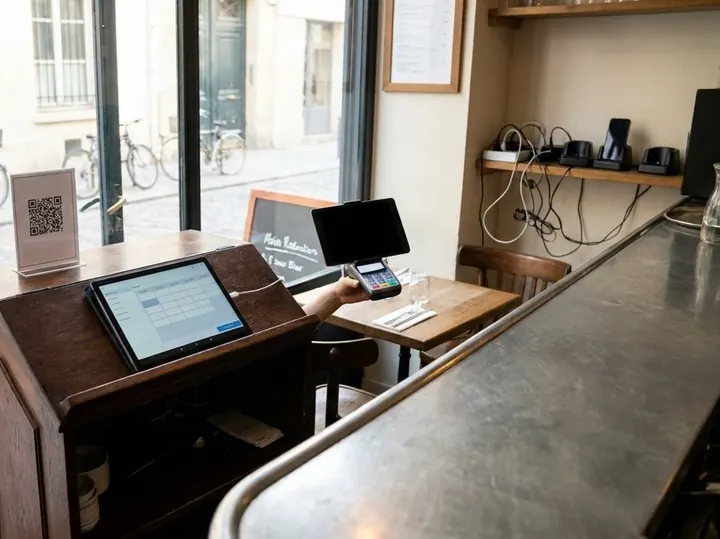
Restaurant Technology Report 2026
A report by Prosus Ventures and Dashmote
Nobody owns the restaurant software stack yet
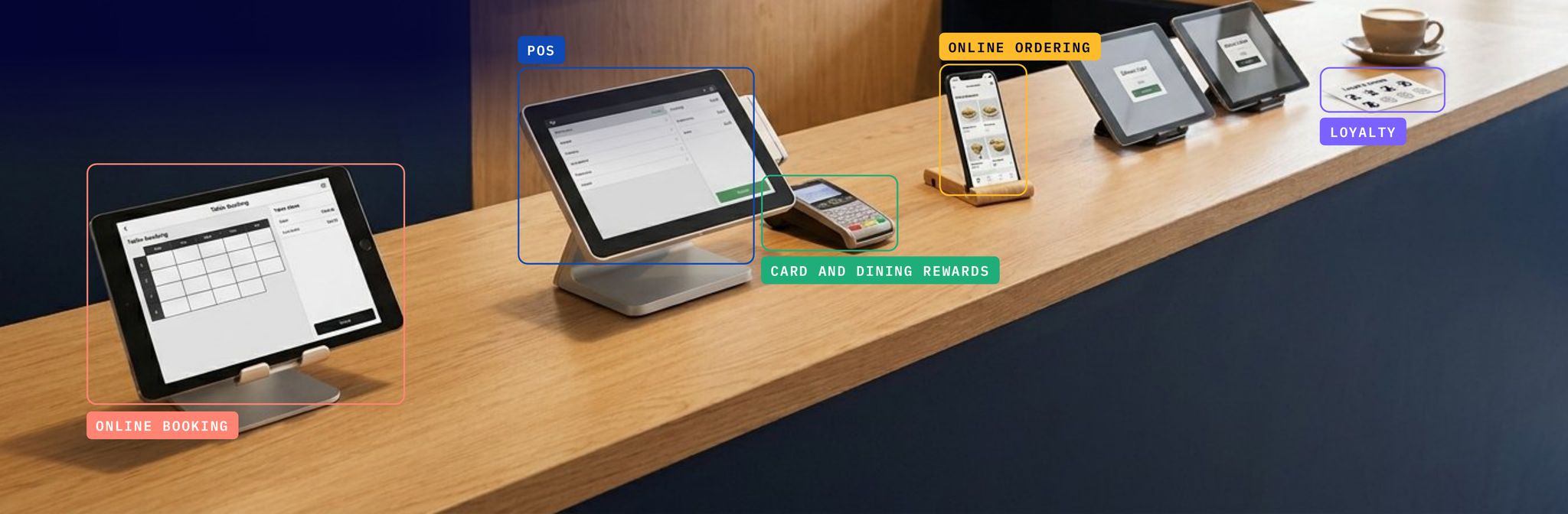
In New York, 57% of eating and drinking places show at most one of the five systems this report tracks: POS, online booking, online ordering, loyalty, and card and dining rewards. London, Sydney and Melbourne show the same pattern.
Restaurant software is still local and fragmented. As AI agents slowly begin to choose and book restaurants for diners, the companies that connect restaurants to those agents have an opening, and the race to fill it has started.
The Restaurant Technology Report 2026 from Prosus Ventures and Dashmote maps who leads in booking, point of sale (POS), online ordering, loyalty, and card and dining rewards across the United States, Europe, Brazil, India and Asia Pacific, and where the market is heading.
“AI agents may soon choose where people eat. But an agent can only act when a restaurant’s systems let it in. This report shows that the door is still wide open: restaurants run a patchwork of local tools, and no one has yet become their operating system. That’s where we want to invest: in the companies that make every restaurant readable, bookable and orderable by agents.”
 Thiago Viana da Silva Global Head, Prosus Ventures
Read the report chapter by chapter


Watch the podcast
Restaurant software is still local
Most places show one restaurant technology system or none, so nobody owns the stack yet. In New York, 30% of places show none of the five systems this report tracks and 27% show one. London, Sydney and Melbourne show the same shape.
Those that use technology buy it one tool at a time, from different vendors, and few trust any single supplier with the whole stack. Of New York Toast places with a second system, four in five use at least one system from another vendor.
- 57% of New York places show at most one of the five systems
- Up to 64% of restaurants in six European cities show no online booking
- Up to 71% of New York places with a POS show no loyalty programme
- 2.8% to 85% of restaurants are listed on a booking platform, from under €15 to €60 and up per person, six European cities
Source: Dashmote restaurant technology data, Oct 2026.
Places by how many of the five systems are seen
The five systems: POS, online booking, online ordering, loyalty, and card and dining rewards.
Source: Dashmote restaurant technology data, Oct 2026.
Switch on what a place shows
The share depends on how many of the five systems are seen, not on which ones.
Source: Dashmote restaurant technology data, Oct 2026.
- Adoption follows price. In six European cities, 85% of restaurants at €60 and up per person are listed on a booking platform, against 2.8% of those under €15. Between chains and independents the gap is far smaller: 29% against 37%.
- Card and dining rewards sit beside restaurant loyalty. In London, 13% of eating and drinking places show card and dining rewards, against 8.5% with their own loyalty programme seen; in New York it is the other way round. In Sydney, 15% show card and dining rewards against 2.1% with a loyalty programme seen, and in Melbourne 14% against 1.1%; chains' own loyalty schemes are not read in these two cities.
- Delivery apps answer with branded pages. Restaurants want their own storefront, but many still rent one from a delivery company. Of New York places whose Google order button offers a direct ordering option, 63% show a delivery company's ordering page in the restaurant's name; in Sydney it is 15% and in London 1.3%. A restaurant's own site can run on a delivery company's software without showing it, so the true shares can be higher.
“Technology is transforming how restaurants interact with their guests, and every restaurant now runs its own set of software, from payments and loyalty to reservations. Yet it is hard to see who uses what, and where. We built Dashmote to bring transparency, venue by venue and city by city, follow the trends locally, regionally and globally, and see where the opportunities are.”
 Dennis Tan CEO and Co-Founder, Dashmote
Watch the films
 Play the film: The race to own the restaurant has started
The race to own the restaurant has started
 Play the film: AI agents want to book your table
AI agents want to book your table
Money and big buyers move in
Funding is rising again, led by a handful of large US rounds. Restaurant and shop technology companies raised $2.2B in 2026 to Q3, against $1.6B in all of 2025. Funding peaked at $4.7B in 2021 and fell to $1.0B in 2023. Of the $2.2B raised in 2026 to Q3, about $1.8B went to restaurant-focused segments, and it includes $775M for Wonder, which runs restaurants and owns Grubhub.
Unicorns are being minted again, valuations are at a record, and Wonder has filed for an IPO. By Dashmote's count from Dealroom.co data there are 14 restaurant technology unicorns, companies valued at $1B or more, listed and acquired included; 2 of them since the start of 2025: Owner and SevenRooms.
- $2.2B raised by restaurant and shop technology companies in 2026 to Q3
- $1.6B raised in all of 2025
- 14 restaurant technology unicorns, 2 of them since the start of 2025
- 48% of 2026 funding to Q3 went to online ordering and delivery, because of Wonder and Owner
Sources: $2.2B, $1.6B and 48%: Dealroom.co, Q3 2026. 14: Dashmote count from Dealroom.co data, Q3 2026.
VC investment by quarter in restaurant and shop technology
Source: Dealroom.co, Q3 2026.
- Outsiders moving in. Consolidation has begun, but the buyers are not only restaurant software companies: delivery apps, card issuers and private equity are buying as well. DoorDash completed its purchase of SevenRooms in Jun 2025 (about $1.15B), PSG Equity combined Zenchef and CoverManager, with more than 36,000 restaurants in 20+ countries (Jul 2025), and Thoma Bravo completed its take-private of Olo in Sep 2025 (about $2.0B). Uber agreed to buy ezCater in Oct 2026, and American Express completed its purchase of TheFork in Nov 2026.
- Online ordering raised the most. By main product, online ordering and delivery took the largest share of funding in 2026 to Q3: 48%, because of Wonder, which runs restaurants and owns Grubhub, and Owner.
- Most of the money is American. US companies raised $1.7B in 2026 to Q3, against $1.1B in all of 2025 (restaurant and shop technology). European companies raised $343M in 2026 to Q3, and one $220M round for Skello, in staff scheduling, was most of it.
AI agents want to book your table
Diners already ask AI where to eat: 22% of US consumers have used an AI tool to help choose a restaurant, and 19% of UK consumers use AI tools to plan a visit to a pub, bar or restaurant. Yet most AI use stops at finding a restaurant. Booking through assistants is live but small, and ordering is rarer still.
The constraint is access: an agent can only act where a restaurant's systems let it in, and many restaurants today are visible only inside the booking tool they happen to use. Whoever opens that door first sets the terms.
- 22% of US consumers have used an AI tool to help choose a restaurant
- 19% of UK consumers use AI tools to plan a visit to a pub, bar or restaurant
- 190,000 diners seated through OpenTable's integration with OpenAI in Sep 2026
- About 500 delivery orders started by an AI agent in one week, counted by Uber Eats
Sources: 22%: DoorDash survey of US consumers, May 2026. 19%: Zonal and NIQ survey of UK consumers, Oct 2026. 190,000: Booking Holdings Q3 call. About 500: Uber, Nov 2026.
Most AI use stops at finding a restaurant
| Market | Find in any AI assistant | Book in any AI assistant | Order in ChatGPT, Gemini, Claude | Order in the app's own assistant | Pay in ChatGPT, Gemini, Claude | Pay in the app's own assistant |
|---|
Statuses as of Nov 2026. Just Eat Takeaway.com is a Prosus company (acquired Oct 2025). iFood is a Prosus company. Prosus holds about 21% of Swiggy.
Source: company announcements and press, Oct 2025 to Nov 2026: iFood via Forbes Brasil; Swiggy; Google; DoorDash; Just Eat Takeaway.com; Booking Holdings; Digital Commerce 360; Canaltech; YouGov; Inc42; Yext; Mobile Time; Zonal and NIQ; Zomato developer documentation (GitHub).
Follow an AI agent through one market
The same statuses as in the table above, as of Nov 2026.
Sources: as listed under the table above.
- OpenTable is on most AI assistants' booking lists. OpenTable is among the booking platforms on four of five AI assistant launches. Its integration with OpenAI seated 190,000 diners in Sep 2026, and it became the first dining partner of Meta's Muse.
- Ordering by agents is still rare. 5% of US consumers have used a fully autonomous AI agent to place orders, while 62% of US diners would order through an AI chatbot given the right offer.
- Many restaurants sit inside one booking tool. In six European cities, up to 64% of restaurants show no online booking. Of those that take bookings online, about half show a booking link on Google, and up to one in five are only in a booking platform's own catalogue.
- Platforms guard the door. Resy deactivated two diners' accounts after their AI agents hunted for tables (both later reinstated; American Express owns Resy), and Amazon blocked Meta's Muse from shopping on Amazon.com in Sep 2026.
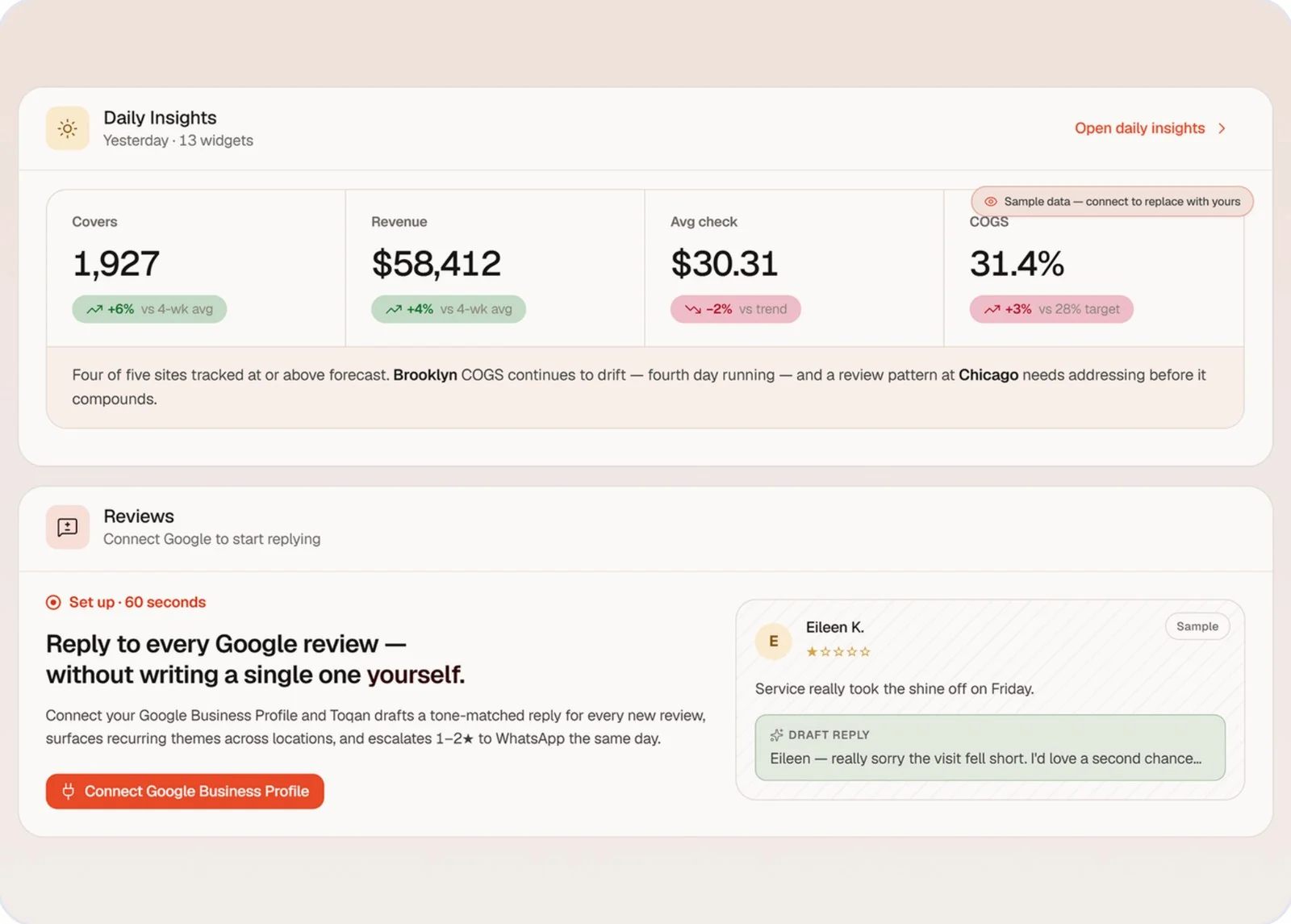
- Partner case: Toqan, Prosus’s agent for restaurant owners. Toqan is Prosus’s AI agent platform. It was launched in June 2026 to restaurants and other SMEs. The no-code platform connects to a restaurant’s existing systems, helping with scheduling, stock ordering, admin and marketing; the owner approves each suggestion. The Toqan agent also helps restaurant owners benchmark against nearby venues, handle reviews and track their social presence, drawing on Dashmote’s venue and menu data. Restaurants signed up within months of launch. Source: Toqan website, Nov 2026; Prosus, Nov 2026.
Every market runs its own race
Winners are local, and the leader changes at almost every border. Each country, often each city, has its own booking, ordering and POS leaders. Global players are strong in the US, UK and Australia; local platforms hold Europe and India. Habit shapes the stack as much as software does, with WhatsApp serving as Brazil's second delivery channel.
Each market has its own leading vendors
Hover or tap a country. Each label names the leader Dashmote measured and, for cities, its share of places; close: the No. 2 is within 5 points. Lighter colour: active in the market; Dashmote does not measure them. iFood, a Prosus company, invested in Anota AI in 2022 and owns Get In. Prosus holds about 21% of Swiggy. PayU, part of Prosus, has invested in DotPe. Prosus has invested in Bilt.
Source: Dashmote restaurant technology data, Oct 2026; company websites and app listings, Nov 2026; Vectron, 2025; Caspeco, Jun 2025; BW Disrupt, Oct 2025; H&L, 2025; Brazil Journal, Feb 2026; Prosus, Nov 2026.
- United States. OpenTable leads online booking nationally, on 52% of restaurants bookable on the six platforms measured, and it leads booking in all but one US metro area. In New York, Toast (40%) and Square (27%) lead visible POS among places with a POS seen, and 73% of pizza places with online ordering seen show Slice.
- Europe. The booking leader changes from country to country: no platform leads in more than three of the 11 countries. Zenchef leads in the Netherlands, Belgium and Luxembourg, TheFork in Italy and Portugal, and OpenTable in Ireland and the United Kingdom. In Berlin, 75% of restaurants bookable online use their own booking software. No POS vendor leads London.
- India. In the Delhi NCR districts measured, 20% of table-service restaurants have a booking-app link on their Google listing, and 52% of them link to more than one app. 98% of these restaurants in Delhi NCR link to Swiggy Dineout or District. Diners already pay by phone: 94% of small merchants surveyed accept UPI. Prosus holds about 21% of Swiggy.
- Brazil. In a March 2025 Abrasel survey, restaurant owners put WhatsApp at 26% of their delivery revenue, second after the delivery apps, by their own estimate. In São Paulo, 16% of food venues show an ordering vendor, far more than show a booking tool; 50 ordering vendors compete there, and Anota AI, a WhatsApp ordering tool, is on 33% of venues with a named ordering vendor. There are 1.1 million restaurants in Brazil, and Totvs-Linx and Colibri serve about 50,000 of them, by the estimate of Takeat's founder. iFood, a Prosus company, invested in Anota AI in 2022 and owns Get In.
- Asia Pacific. A regional platform leads online booking in seven of the eight Asia Pacific countries with a named leader. In Singapore, Chope is on 54% of restaurants with online booking seen, 3.5 times the No. 2. Global platforms are strong in Australia: OpenTable is on 63% of Melbourne places with online booking seen, and Square is the POS seen most often in Sydney and Melbourne. Card and dining rewards, led by the dining club EatClub, reach 15% of Sydney places.
What comes next for restaurant technology
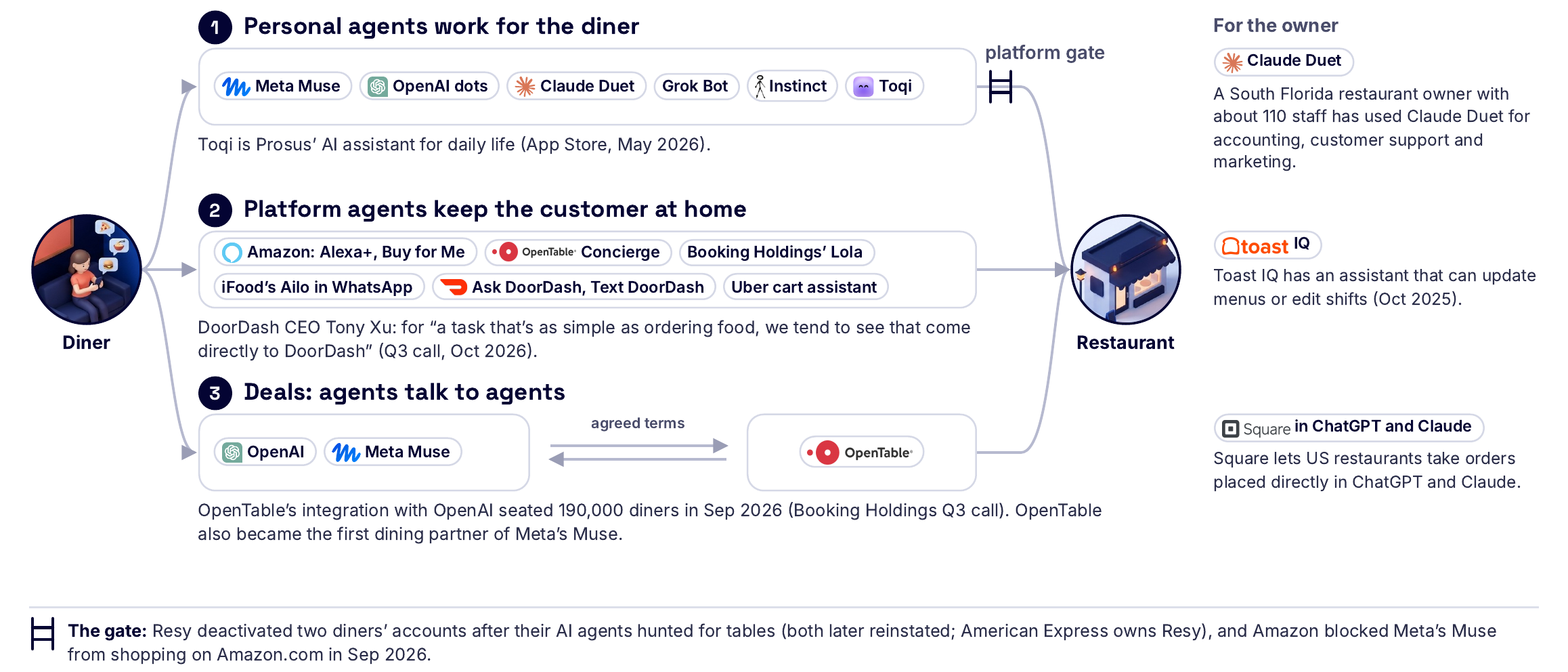
AI agents could reach restaurants in three ways.
- Personal agents work for the diner. More than 10 million people in the US and Canada have set up Meta's Muse, a personal AI agent that also works inside WhatsApp. Toqi (Prosus) finds products, compares prices, reviews and delivery options, and places an order once the user approves; it cannot pay on the user's behalf.
- Platform agents keep the customer at home. Delivery and booking apps build their own assistants, from iFood's Ailo in WhatsApp to Ask DoorDash and Uber's cart assistant. iFood is a Prosus company. DoorDash CEO Tony Xu: for “a task that's as simple as ordering food, we tend to see that come directly to DoorDash” (Q3 call, Oct 2026).
- Deals: agents talk to agents. Booking platforms agree terms with AI companies: OpenTable's integration with OpenAI seated 190,000 diners in Sep 2026, and OpenTable became the first dining partner of Meta's Muse.
Three routes: personal agents that work for the diner, platform agents that keep the customer at home, and deals in which agents talk to agents.
Robotics start-ups are building for the kitchen as well. The report's map of AI and robotics start-ups for restaurants names kitchen-robot makers such as Miso Robotics in the United States, goodBytz in Europe and TechMagic in Asia Pacific and India, and kitchen robot and vending companies raised $73M in 2026 to Q3.
The report, market by market
Pick a market to see what the report shows there.
Talk to the teams behind the report
Want this data for your market?
Dashmote tracks restaurants in 60+ countries and 100+ platforms.
Contact DashmoteAbout the report
The Restaurant Technology Report 2026 reads each restaurant's public signals, such as its website, booking and ordering widgets, map listings and delivery storefronts, to see which POS, online booking, online ordering, loyalty, and card and dining rewards systems it runs. It covers New York City and US metro areas, six European cities and 11 European countries, São Paulo and Rio de Janeiro, Delhi NCR and Mumbai, and Singapore, Australia and New Zealand.
Restaurant data are from October and November 2026; funding figures are Dealroom.co data on restaurant and shop technology to the end of September 2026. Shares of systems seen are minimums, because a system that leaves no public trace is not counted; 'up to' marks an upper bound, for the same reason. Dashmote tracks restaurants in 60+ countries and 100+ platforms.
About the partners
About Prosus Ventures
Prosus Ventures is the early-stage investment arm of Prosus, one of Europe’s largest technology companies. We back founders building the technologies that will shape Prosus’s ecosystems over the next decade. Since 2015, we’ve invested $2.3B+ in more than 100 startups across 20+ countries. We invest from Prosus’s own balance sheet, not a third-party fund. That means we have no fund cycle to work around, and founders get a direct line into a portfolio of 100+ businesses that serve more than a billion customers across Latin America, India and Europe.
About Dashmote
Dashmote is a restaurant outlet data & AI company that uses AI to map the out-of-home food and drink market restaurant by restaurant, in 60+ countries and across 100+ delivery platforms: the booking, POS, online ordering, loyalty and rewards systems each venue runs, its menus and its delivery storefronts. Food and drink brands, technology providers and investors use it to size markets, find accounts and track share. AI agents can read it directly through Dashmote’s API and MCP server. Backed by investors from the United States and Asia, and named Best Startup by Google and McKinsey.
Data partner: Dealroom.co
Dealroom.co is a data platform on startups, scale-ups and venture capital funding, used by investors, companies and governments. It supplied the funding pages of this report.
Receive email alerts on the latest content from Prosus.